
What Is an Automatic Packaging Machine? (And Why Every Manufacturer Needs One)
If your packaging line still depends heavily on manual labor, you're likely leaving speed, consistency, and profit on the table. An automatic packaging machine has fundamentally changed how modern manufacturers think about production — and for good reason.
So, What Exactly Is an Automatic Packaging Machine?
At its core, an automatic packaging machine is a fully integrated system that handles the complete packaging process — forming, filling, sealing, labeling, and product discharge — with minimal human intervention. These machines rely on PLC-driven automation and servo motion technology to synchronize every step in real time. In today's smart factories, they act as the backbone of a connected packaging line, working alongside conveyors, inspection systems, and secondary packaging equipment to deliver seamless, high-speed operations
Why Are Manufacturers Switching from Manual to Automated Packaging?
Manual packaging has a ceiling — and most growing manufacturers hit it fast. Operator fatigue, inconsistent speeds, and human error create bottlenecks that cap production capacity no matter how large your workforce is. Automation breaks through that ceiling entirely.
Here's what the numbers show:
- Automated lines run up to 3x faster than manual setups
- Labor requirements drop by 30–50% for packaging tasks
- Packaging defects reduce by up to 80% through precision sensors
- Runtime efficiency reaches 97%, versus roughly 74% for manual lines
These aren't marginal gains — they're transformational.
How Does an Automatic Packaging Machine Improve Efficiency?
Speed at scale. These machines process over 1,200 units per hour — far beyond the 300–400 units achievable manually — letting you scale production without scaling headcount.
Material precision. Advanced control systems maintain dimensional accuracy within fractions of a millimeter, reducing packaging material waste by 22–30%. That's both a cost and sustainability win.
Built-in quality assurance. Integrated machine vision, checkweighers, and seal inspection systems catch defects in real time before any faulty pack reaches your supply chain.
Elastic scalability. Automated lines scale up to eight times faster than traditional setups, with uptime approaching 99% during peak periods.
The Technologies That Make It Work
Modern packaging automation combines several engineering disciplines:
Servo Motion Control keeps film feeding, filling, and sealing perfectly synchronized for high throughput without sacrificing accuracy.
PLC-Based Control Systems coordinate all machine movements and give operators full visibility through intuitive HMI interfaces.
Vision Inspection Systems verify label placement, barcode readability, and seal integrity — keeping output compliant with quality and regulatory standards.
Modular Architecture lets manufacturers add labeling, coding, or robotic handling modules as production demands grow.
Where Secondary Packaging Fits In
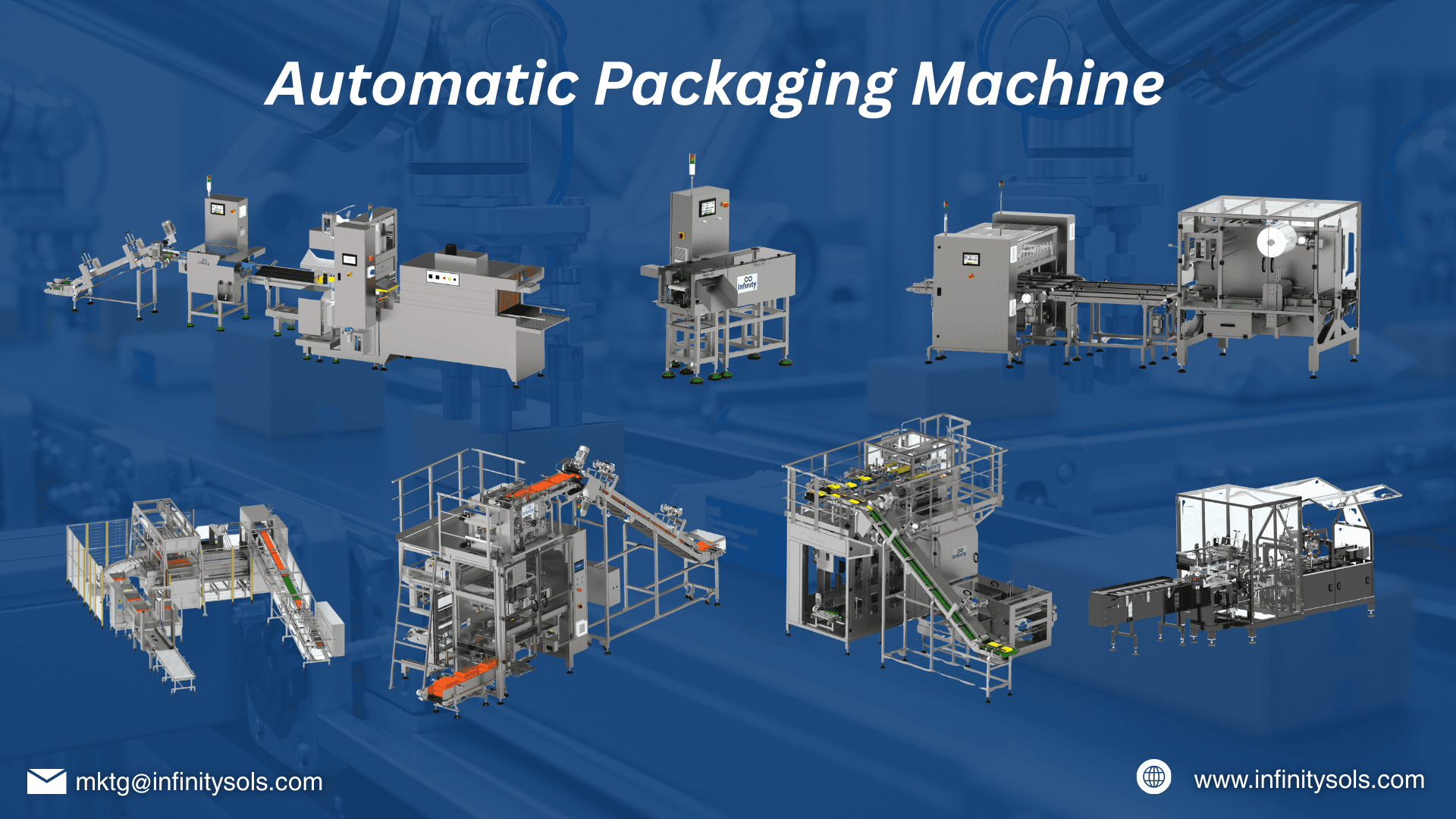
Primary packaging is just the beginning. Once products are packed, they need to be grouped, bundled, cartoned, and prepped for logistics. That's where secondary and end-of-line equipment steps in — pouch bundlers, automatic baggers, cartoners, case packers, and checkweighers that prepare goods for storage and distribution.
Infinity Automated Solutions Pvt. Ltd. specializes in advanced secondary packaging machines that integrate seamlessly into automated lines to maximize end-to-end throughput.
What's the ROI?
The financial case is strong. Most projects deliver 30–40% productivity gains and measurable reductions in labor and material costs, with payback periods between one and two years. Automation also improves worker safety by eliminating repetitive, physically demanding tasks.
Where Is This Technology Headed?
The next generation of automatic packaging machines is already here. Powered by Industry 4.0, these systems now offer real-time monitoring, predictive maintenance, AI-powered inspection, and digital twin simulation. As sustainability demands and supply chain traceability requirements grow, the automatic packaging machine will remain central to competitive manufacturing.
The question is no longer whether to automate — it's how soon.